Donor First (DFX): Enhancing Transparency for Donor-Advised Funds
Ren Inc. | UX Research Lead & Designer
February 2025 - December 2025 • Capstone Project
Problem
Donors were the least-engaged user group on Ren Inc.'s donor-advised fund (DAF) platform, but they held the funds. Ren had hunches on how they could boost engagement, but without understanding donors' actual motivations and experiences, any new feature would be a guess.
Goal
We needed to understand what actually drives donors to start a DAF, how they currently engage with the account, and what is lacking in the current donor experience so that any features Ren built would map to real behavior, not assumptions.
My Role
I led end-to-end research strategy and execution: scoping the study, designing interview guides, recruiting participants, and running sessions. I shaped how findings translated into design direction and stayed involved through prototyping to keep decisions grounded in what we'd learned. All the while, I was the point of contact for stakeholders.
Tools:
Figma
Google Scholar
Miro
Zoom
Methods:
User Interviews
Competitive Analysis
Contextual Inquiry
Affinity Mapping
Think-Aloud Protocol
Meet Our Redesign of the Donor First Platform (DFX)
Before Our Redesign
The DFX treated donors like they were financial advisors: account maintenance, charity search, donate, done. The product assumed donors were solely there for the tax benefits.
What we found was the opposite:
• Donors more often had genuine philanthropic intent, either opening their DAFs as someone who regularly makes donations, or looking to start.
• Donors and charities were holding back their communication to avoid bothering the other or avoid being bothered.
• Repeated accounts from charities and financial advisors that the few donors that do opt for anonymity don't realize it means from the charity.
After Our Redesign
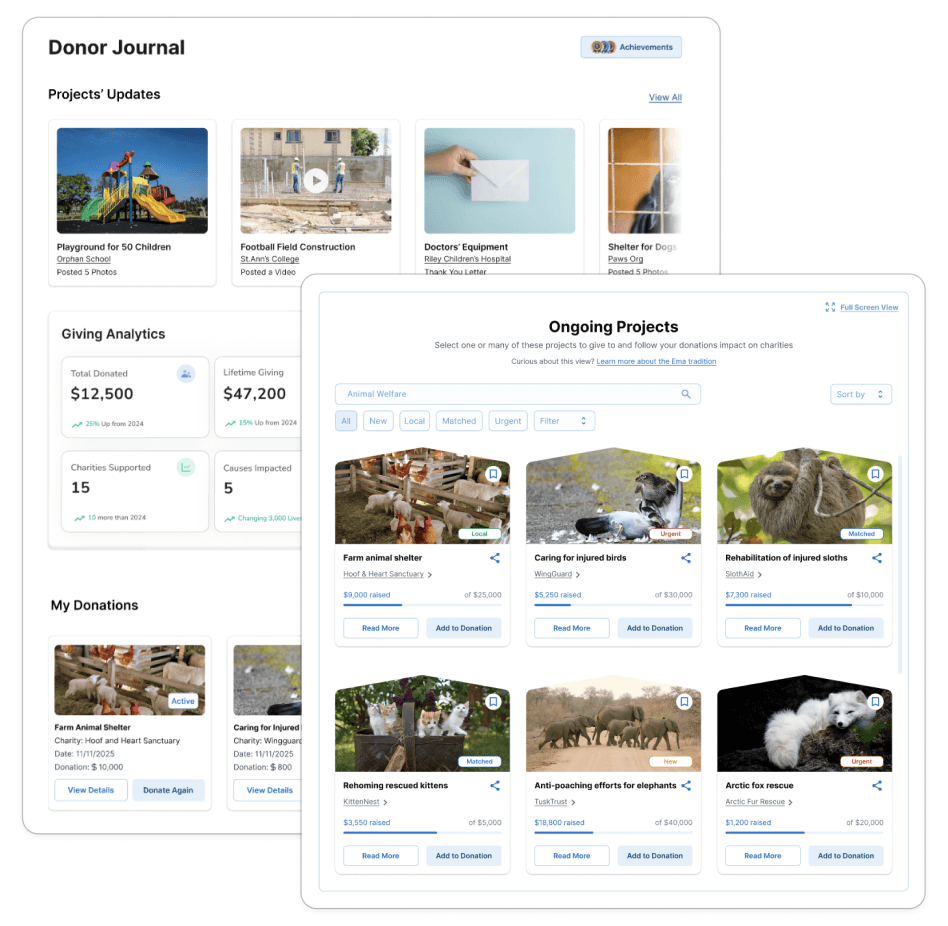
Our design incorporated features that addressed the needs and interests of donors: charitable impact, easy access to causes, and a story-based view of their account, instead of just numbers.
What we built:
• Ongoing Projects board for donors who don't know where to start and charities to have their work highlighted agnostically, with no liability from Ren by "supporting" causes.
• Donor Journal & Impact Profiles as a structured way for charities to share updates and donors to see their impact, without either party reaching out.
• Granular anonymity controls fixing the communication breakdown with acknowledgements.
Project Impact

Challenged the product team's core assumption about donor motivation, shifting the design direction from account maintenance toward philanthropic engagement.

Designed a unique donor experience that none of Ren’s competitors have implemented solutions for, setting them apart.

Received a final SUS score of 87.5 in user testing, indicating our product is both desirable and easy to use for donors, resulting in its prioritization for 2026.

Uncovered a donor anonymity blindspot that directly reshaped how the platform communicates and controls privacy settings.
If you're interested in a deep dive into this project, keep scrolling!
Otherwise, view my next case study, or jump back to the Home page
Project Deep Dive
Background
Ren Inc. is a leading provider of philanthropic technology and managed services in North America. The company focuses on enhancing philanthropic impact by providing expertise, technology, and scalable solutions for charitable giving.
140+
institutions, including nonprofits, universities, and financial firms. supported by Ren Inc.'s DAF platform
$175B+
in charitable assets managed by Ren, with $50B+ in donations through donor-advised funds, charitable trusts, and private foundations.
~50%
of all U.S. DAF assets use Ren technology for management and donations.
Their primary focus is on their platform that facilitates donor-advised funds, the Donor First platform, or DFX for short.
Donor-advised funds (DAFs) are charitable giving accounts held by high-net-worth individuals, in collaboration with a financial advisor, where contributed assets can grow in value, tax-free until they decide to make a donation.
Design Brief
My team's work with Ren Inc. was part of my Master's Capstone Project, spanning two semesters and serving as the final project of my HCI Master's program. We decided to pursue this collaboration out of passion for philanthropy and a desire to do meaningful work in the fintech space.
Ren revealed to us an interest in exploring the idea of "closing the loop" for donations made by DAF donors. Through their own research, they discovered an opportunity to expand their Donor First platform by keeping donors connected to their philanthropic efforts, not with numbers, but with stories. This interest gave us a starting point for our research.
Ren's Hypothesis:
If donors had a better idea of where their money was going once released to the charity and more options for engagement, it would boost their interest and motivation to be more involved with the platform.
Research Approach
Even though Ren had their own hypothesis for enhancing donor engagement, we still needed to validate it while digging into donors' general pain points.
Early on, we chose user interviews for their flexibility. This would let us target both discovery and validation without leading participants or locking into the wrong questions early. We focused on two audiences, with ideas of what we should learn from them:
Donors:
In particular, why do donors open donor-advised funds?
By understanding their motivation in opening the fund, we can identify if they even feel motivated by their philanthropic impact, or if it's just a desire for tax benefits. This helps us decipher if there really is interest from donors to be more engaged with the platform.
What desires or needs do donor-advised funds and their platforms fulfill for donors, and where are they lacking?
This allows us to look at how their motivations change or are fulfilled once the fund is up and running, as well as general satisfaction with the experience of having the fund. This allows us to get more targeted feedback of donors' interactions with the platform.
Charities:
Are there any unique aspects of donor-advised funds that make them particularly beneficial or frustrating to receive donations from?
This helps us understand the pros and cons charities experience when interacting with donor-advised funds as a whole. If we have to design any features that they need to interface with, this will help us know what frustrations we could remedy, or at least not exacerbate.
How does the experience of stewardship with donor-advised fund donors differ from other donors?
By diving into what makes donor-advised funds unique from other giving avenues in terms of stewardship, we begin to understand what the general expectations for maintaining relationships with DAF donors are. Charities also witness donor behavior after a grant firsthand, including how they respond to outreach.
Research Plan
Literature Review
Reviewed existing literature on donor-advised funds and philanthropy, allowing us to understand the problem space
Competitive Analysis
Researched 4 direct competitors, 3 indirect competitors, and 2 companies innovating in the philanthropy space
Expert & Stakeholder Interviews
Discussed our project with an expert at the Lilly School of Philanthropy and with 4 stakeholders at Ren to define project success
User Interviews
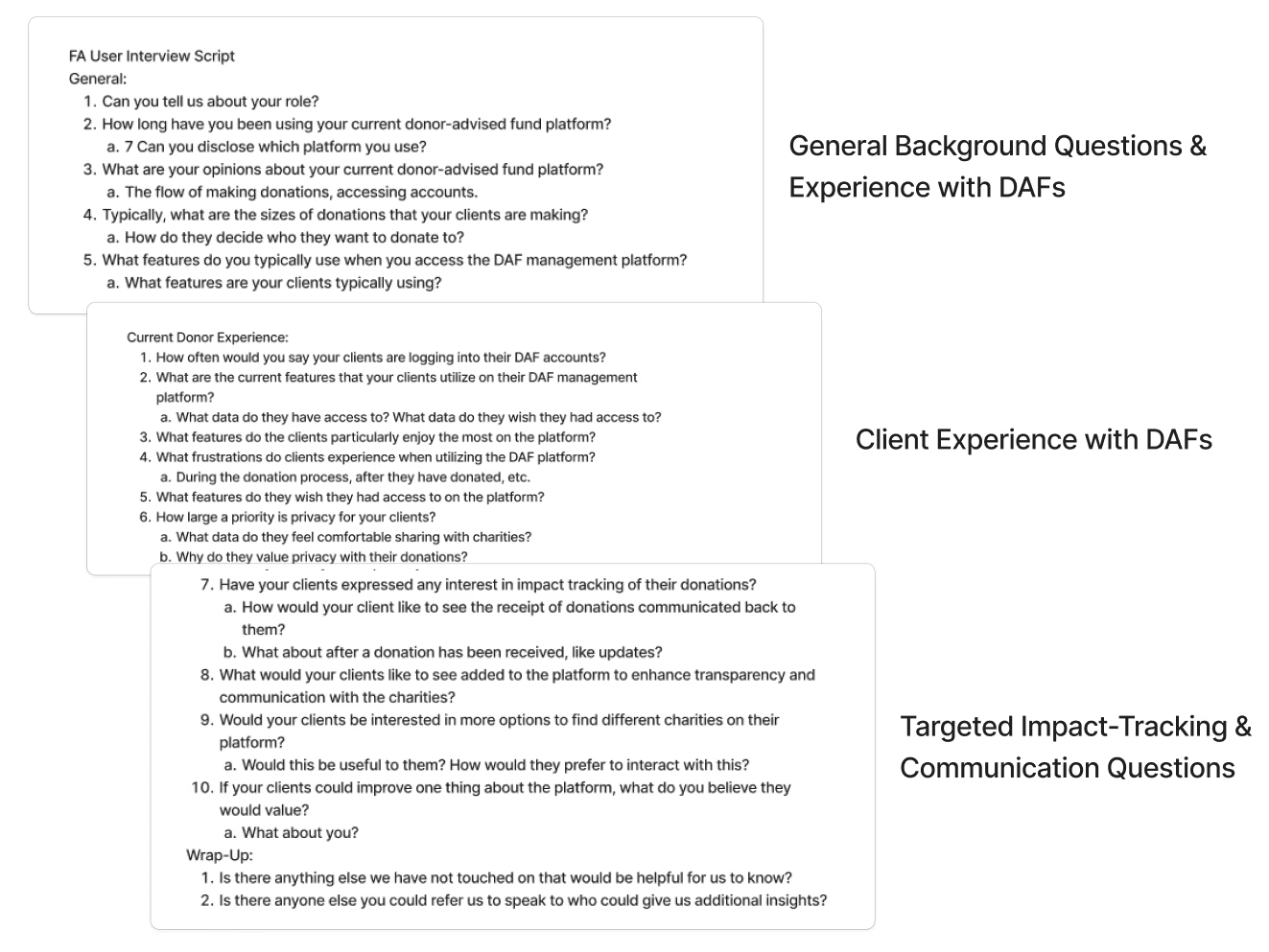
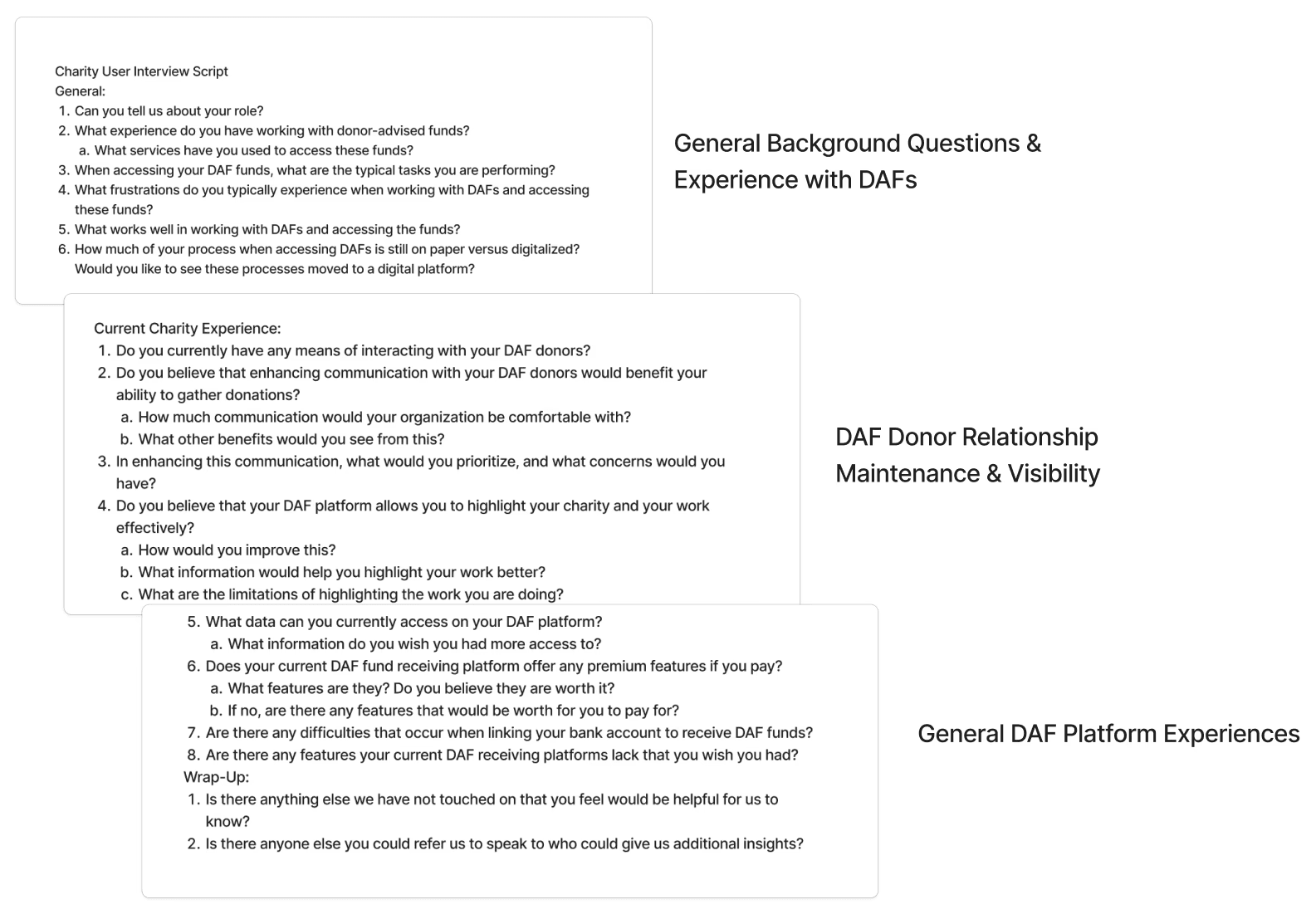
Interviewed 6 financial advisors who work with donors to manage their DAF and 6 charities that accept DAF funds to understand experiences of both donors and charities
Secondary Research Results
Secondary research significantly enhanced our understanding of the market and problem space. We were able to gather major findings that made us more informed in conducting our primary research. Some of our major takeaways from this phase included:

Charities
Charities have highly variable capacity for donor communication, requiring stewardship solutions that are flexible and non-burdensome.

Donors
DAF donors value control over their engagement with charities, but their expectations vary widely based on motivation, net worth, and desired level of involvement.

Strategy
Existing solutions either treat DAFs as an add-on to financial services or emphasize donor engagement without DAF functionality. This gap reveals an opportunity to differentiate Ren.
Primary User Research Design & Results
Going into the primary research phase, we were immediately hit with a hurdle: "How can we get permission to conduct research on donors?" Naturally, donors can be hard to access for numerous reasons:
Some donors donate anonymously, making them disinterested in being contacted by parties outside of their financial management teams
Financial advisors are hesitant to pass along their donor contacts out of concern for bothering them, since they are already very busy people
There is no repository of people who make donations via donor-advised funds.
Rather than treating this as a blocker, I reframed our recruitment around proxies who could give us rich, attitudinal insight at scale: financial advisors (each representing many donors) and charity representatives (who witness the donor relationship from the other side).
Study Design
Our study consisted of interviews completed with 2 user groups: financial advisors and charity representatives. The groups were not offered incentives to participate.
6 Charity Representatives
Including gift managers, directors of donor outreach, and philanthropy officers. Recruited via cold email and LinkedIn, targeting a deliberate mix of 2 nationwide, 1 statewide, and 2 citywide organizations, stratified by annual donations received and staff size.
6 Financial Advisors
Sourced from the NAPFA (National Association of Personal Financial Advisors) database, filtered for advisors specializing in charitable giving to ensure DAF familiarity. Recruited via cold email to their offices.
Findings
We synthesized the results of our user interviews by affinity mapping in Figjam. It was surprising the amount of overlap about donor experiences that emerged from the financial advisor and charity interviews. Overall, we had 6 major findings that we condensed into overarching themes.
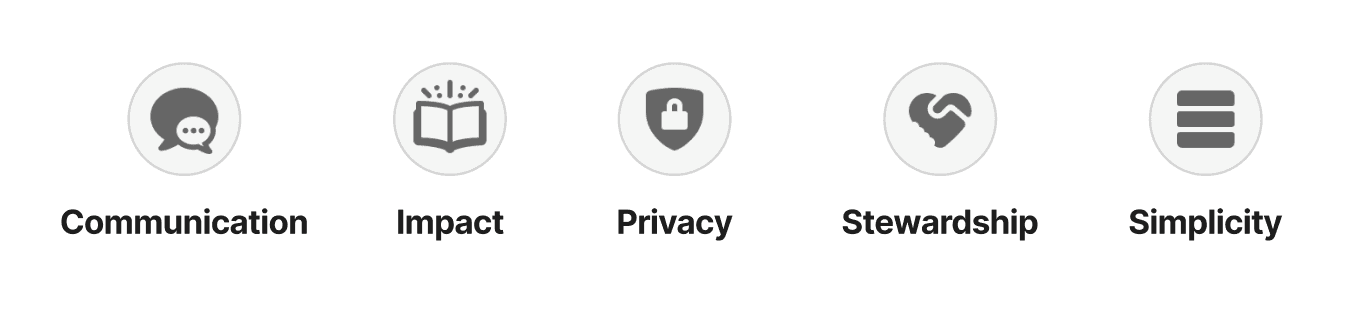
While communication and impact mostly pertain to donors, and stewardship and simplicity to charities, both groups reach a mutual understanding of the importance of privacy. Our specific findings were as follows:
Finding: Most DAF Donors Were Giving Charitably Before Opening Their DAFs
Financial advisors reported most of their clients were motivated by philanthropy to start their DAFs, because they had a history of giving anyway. Even if a donor made donations prior to opening their DAF mostly for a tax write-off, they were still giving to organizations they cared about such as schools, churches, and hospitals they had ties to.
This showed us that generally donors do care about the causes they give to, even if there is a tax-benefit motivation as well. Further, this also revealed to us that often donors open their DAFs knowing who they will be making donations to.
Recommendation:
Our designs can utilize features that draw on the fact that donors do generally care about the causes they are giving to.
This was a really important finding for us because if we found out that donors don't actually care about philanthropy or the charities they give donations to, then the entire basis of trying to boost donor engagement by enhancing communication and connection to the impact of their charitable giving completely falls apart.
This helped support moving forward with Ren's hypothesis that , "If donors had a better idea of where their money was going once released to the charity and more options for engagement, it would boost their interest and motivation to be more involved with the platform."
Finding: There is a Smaller, but Prevalent Group of Donors Who Need Help Finding Causes
There are 2 less prominent types of donors. One type opens a DAF wanting to begin a charitable legacy, but doesn't know where to start. The other type wants to maximize their tax benefits while giving more indiscriminately to causes they care about.
These 2 smaller groups are important because it expands our problem space from just focusing on impact tracking and communication to also considering discovery.
Recommendation:
Ensure our donor-engagement features include donors who already know who they want to give to and donors who need help finding who to give to.
This approach opens the door to new users who lack that background knowledge. Donor engagement becomes part of the DFX platform experience from day one, rather than something they unlock once they've put in extra effort elsewhere to find charities to give to.
Finding: Anonymity Is Widely Misunderstood
Contrary to assumptions, very few DAF donors are anonymous. Charities and financial advisors also report donors being confused about what anonymity actually meant, often assuming that they were refraining from their information being shared publicly, not from the charity as well.
This resulted in donors who marked themselves to remain anonymous calling charities to check that their donation was received, upset that they never heard anything
from the charities.
Recommendation:
Clarify anonymity options through clearer language and controls, allowing donors to choose visibility levels, and build the platform to manage communication for charities in line with the chosen donor preferences.
Options must make it clear what communications donors are agreeing to receive, and incorporate management systems and guardrails to prevent unwanted communication.
Finding: Acknowledgment Drives Donor Satisfaction
Donors consistently valued being acknowledged. Personalized, direct communication from charities made donors feel appreciated and informed. They also wish they could feel more connected to the donation they made beyond the acknowledgment.
Donors care about communication that feels like it actually pertains directly to them and their giving, not generic outreach messaging.
Recommendation:
Support features that allow charities to thank donors through acknowledgements as a one-time communication and share relevant updates for their DAF donors in a simple, repeatable way that fits into existing workflows.
Design for this recommendation will largely be a balancing act of making it easier and more lucrative for charities to enhance their outreach methods in ways that actually engage DAF donors, not just soliciting donations.
Finding: Impact Matters, but Effort Must Stay Low
Donors and charities expressed remarkably similar needs: both value transparency and impact visibility, but are cautious about overwhelming the other side with excessive communication.
Donors don't want to put in additional effort to request updates or to become "that donor" who bothers stretched-thin charities.
DAF donors are a high-priority stewardship opportunity for charities due to their perceived wealth. While most never follow up for more than a generic update on their donation, they do run into the occasional prying DAF donor, which can be disruptive to their tight operations.
Recommendation:
Design communication tools that balance visibility with restraint, allowing impact updates to be shared without increasing administrative burden for charities or notification fatigue for donors.
Must offer more options for communication preferences than the current black-and-white anonymous or not setting.
Target lightweight impact storytelling, such as project-level updates or summaries, rather than granular donation tracking.
Finding: Donors are More Diverse, Charities More Uniform
Charity Representatives who often handle DAFs skew towards an older demographic (45-65) and are mostly familiar with legacy systems that have not changed much in the last few decades.
Meanwhile, donors vary greatly in age, profession (financial advisors mention many of them work in tech), net worth, and interests.
This point reinforces that we need to consider charities' resources and not disrupt workflows of representatives. For donors, there's more wiggle room, but still the constraints of a large, segmented population.
Recommendation:
Focus on familiar patterns and simplicity when designing for charities. Usability with their needs in mind is paramount for new features.
Since donors are such a varied group, we have some space to innovate, but we also must consider the needs of the most limited user first, then expand outward.
By employing universal design principles to designs for donors and charities, we create a strong base for users working with the most constraints.
Problem Statement
With the results of our research in mind, we honed in on a problem statement and a "how might we" statement representative of our findings.
While lengthy, they were designed with targeted research data from the user perspective, making it easier to communicate the user needs back to the stakeholders. It also allowed us to discuss findings that pertained to aspects of the user experience that our initial problem space did not address.
“As a donor,
When I’ve made my charitable contributions for the year,
I want to keep up with the donations I gave to charities, maintaining a connection,
So I can feel a greater sense of involvement from the impact my dollar has made,
But the current process offers little control or access to track if my donation was received, let alone creating a connection with my chosen charities,
Resulting in frustration from the all or nothing approach to communication with charities, creating a disconnect.”
How might we…
empower donors by allowing them to easily track and understand the impact of their contributions while preserving control and choice in communication with charities?
Design
With the research phase complete and our problem statement defined, it came time to begin ideating on how we would tackle this complex issue of control, connection, and communication.
Ideation
We kicked off our ideation phase with a design workshop where we reviewed research findings and began sketching ideas. As we discussed the different ideas we came up with, we noted where they overlapped and which problems they addressed.


Our Solution
We decided to pursue individual project donations in our design. This was largely because it was the most balanced approach to our findings within the donor user group, and when comparing the needs of charities to donors.
Individual Project Donations
Relevant themes: Impact, Stewardship, Simplicity
• Expand charity search and charity profiles by featuring individual projects
• Charities post selected projects that they feel they can reliably keep up with updates on
• Donors donate directly to the projects and are subscribed to project updates, receiving notifications in-line with their notification settings.
Design Walkthrough
Testing
For our testing phase, we were fortunate to be able to test with 3 donors, recruited with the assistance of Ren. Testing sessions consisted of a think-aloud protocol, a modified A/B survey, and a final System Usability Scale.
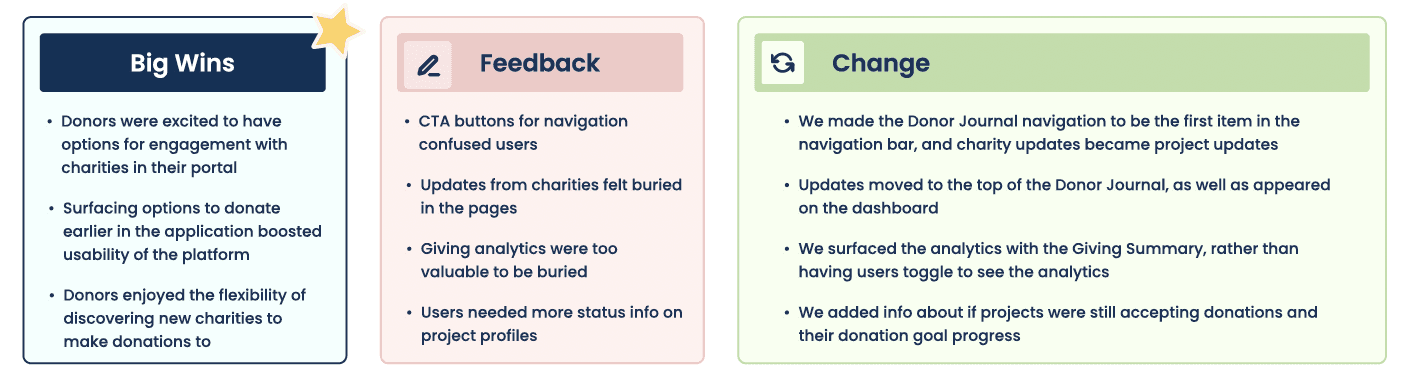
Since our discovery phase relied on proxies and we had limited time left in the semester, we designed a session that had to work hard: capturing genuine first impressions, resolving outstanding design decisions, and producing quantifiable results.
Each session combined three methods deliberately. A think-aloud protocol captured donors' unfiltered reactions as they encountered the redesigned interface for the first time. A modified A/B survey addressed design decisions we couldn't confidently make without real donor input, like whether the Ongoing Projects board should be a widget or a full page. An SUS scale grounded everything in a quantitative baseline, completed anonymously to protect honesty.
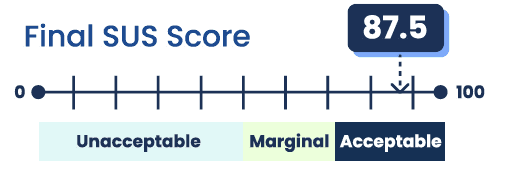
The results validated our core direction. Donors responded strongly to the idea that their giving could be something they follow over time, not just a grant sent into the void. The final SUS score of 87.5 confirmed the design was both usable and desirable. Minor adjustments surfaced in testing are already reflected in the design above.
Considering Uncertainty
Since we had such a small sample size (n=3), I decided to run an additional Bayesian Analysis to understand the credibility of our SUS score.
For this, I incorporated the industry benchmark SUS of 68 with a moderately informative prior (SD=10) to reflect that while 68 is a reasonable baseline, financial services desktop applications tend to skew slightly lower due to task complexity and dual user types. Individual participant scores ranged from the low-to-mid 80s, yielding a sample mean well above the industry average. The 95% Bayesian credible interval ranged from 76.6 to 92.2, indicating a 95% probability that the true mean SUS score falls between 76.6 and 92.2, exceeding the industry benchmark of 68.
Outcomes
This project marked the culmination of my Master's program in HCI.
Ultimately, our group was extremely proud of the work we accomplished throughout our collaboration with Ren. We loved the complexity of the research and the creative problem-solving required for the design phase. Working with Ren further deepened my love for industries like fintech that require diligence and action for bringing innovation to life. Most importantly, I'm proud of the fact that our work was so well supported and received by the Ren team, that it's made its way on the Donor First platform's roadmap for 2026.

In the end, I am proud to say that we successfully:
• Challenged the product team's core assumption about donor motivation, shifting the design direction from account maintenance toward philanthropic engagement.
• Uncovered a donor anonymity blindspot that directly reshaped how the platform communicates and controls privacy settings.
• Designed a unique donor experience that none of Ren’s competitors have implemented solutions for, setting them apart.
• Received a final SUS score of 87.5 in user testing, indicating our product is both desirable and easy to use for donors, resulting in its prioritization.
Reflection
What Made This Project Stand Out
Our stakeholders trusted us with real problems they genuinely wanted solved, giving us direct access to product managers, executives, and even the CTO. In a complex, regulated problem space, that level of investment made a significant difference in the quality and direction of our work.
What I Navigated
The most meaningful challenge was conducting discovery research without access to our primary users. Donors are notoriously difficult to reach. They are busy, averse to solicitation, and in some cases, deliberately anonymous. After exhausting efforts to source contacts through charitable foundations, I pivoted to interviewing financial advisors and charity representatives instead. Financial advisors provided a longitudinal view of the DAF experience from account creation through ongoing maintenance, while charities illuminated what happens after a donation is made. Together, they covered the full grant-making lifecycle, and as the two other key user groups on DAF platforms, their perspectives were worth capturing in their own right.
I was also proud of how our team protected the discovery phase. The client came in with existing hypotheses and a lean toward specific solutions. Validating donor attitudes before building allowed us to disprove some assumptions and reinforce others, sharpening our approach before any design decisions were made.
What I'd Do Differently
Looking back, I'd have pushed harder to gather some direct donor data early on. A brief, anonymous unmoderated survey could have validated our third-party interview findings without the access barriers that ruled out lengthier moderated research, strengthening our insights while remaining realistic to execute.
Finally, I wish we had gotten feedback from some of the charity representatives about our design of the charities’ flow when uploading projects to the platform. While the donor flows were our main priority, I think it was the right move for us to actually build out something to demonstrate an idea of how charities could be uploading projects. In reality, this piece has to exist for the donor experience to exist. However, I think it would have been much more insightful for Ren to have some feedback and data about the experience we designed, to see if the simplicity we strived to incorporate into the feature translated well, and if there was enough trust in AI for them to be open to using it.