Donor First (DFX): Enhancing Transparency for Donor-Advised Funds
Ren Inc. | UX Research Lead & Designer
February 2025 - December 2025 • Capstone Project
Problem
Donors were the least-engaged user group on Ren Inc.'s donor-advised fund (DAF) platform, but they held the funds. Ren had hunches on how they could boost engagement, but without understanding donors' actual motivations and experiences, any new feature would be a guess.
Goal
We needed to understand what actually drives donors to start a DAF, how they currently engage with the account, and what is lacking in the current donor experience so that any features Ren built would map to real behavior, not assumptions.
My Role
I led end-to-end research strategy and execution: scoping the study, designing interview guides, recruiting participants, and running sessions. I shaped how findings translated into design direction and worked on the prototype, keeping decisions grounded in what we'd learned. All the while, I was the point of contact for stakeholders.
Tools:
Figma
Google Scholar
Miro
Zoom
Methods:
User Interviews
Competitive Analysis
Contextual Inquiry
Affinity Mapping
Literature Review
Meet Our Redesign of the Donor First Platform (DFX)
Before Our Redesign
The DFX treated donors like they were financial advisors: account maintenance, charity search, donate, done. The product assumed donors were solely there for the tax benefits.
What we found was the opposite:
• Donors more often had genuine philanthropic intent, either opening their DAFs as someone who regularly makes donations, or looking to start.
• Donors and charities were holding back their communication to avoid bothering the other or avoid being bothered.
• Repeated accounts from charities and financial advisors that the few donors that do opt for anonymity don't realize it means from the charity.
After Our Redesign
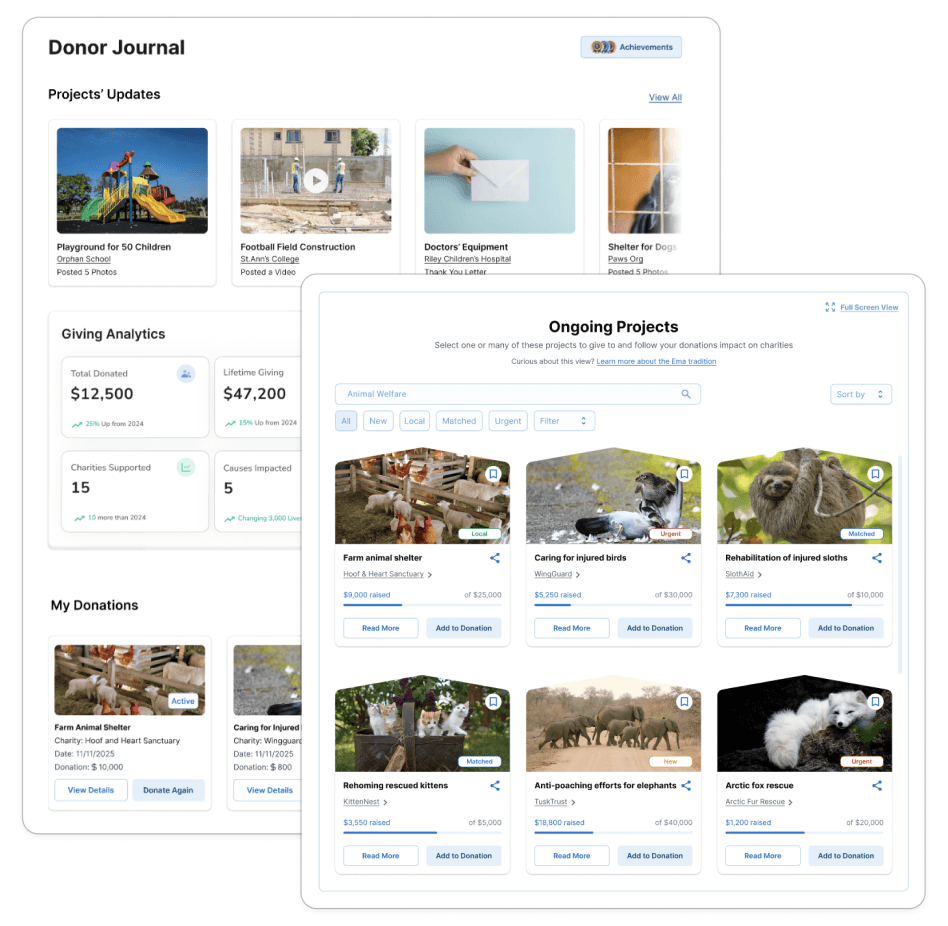
Our design incorporated features that addressed the needs and interests of donors: charitable impact, easy access to causes, and a story-based view of their account, instead of just numbers.
What we built:
• Ongoing Projects board for donors who don't know where to start and charities to have their work highlighted agnostically, with no liability from Ren by "supporting" causes.
• Donor Journal & Impact Profiles as a structured way for charities to share updates and donors to see their impact, without either party reaching out.
• Granular anonymity controls fixing the communication breakdown with acknowledgements.
Project Impact

Challenged the product team's core assumption about donor motivation, shifting the design direction from account maintenance toward philanthropic engagement.

Designed a unique donor experience that none of Ren’s competitors have implemented solutions for, setting them apart.

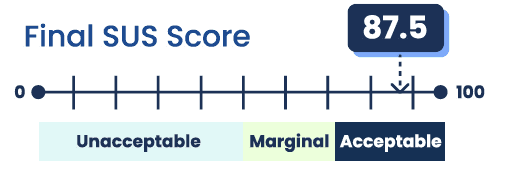
Received a final SUS score of 87.5 in user testing, indicating our product is both desirable and easy to use for donors, resulting in its prioritization for 2026.

Uncovered a donor anonymity blindspot that directly reshaped how the platform communicates and controls privacy settings.
If you're interested in a deep dive into this project, keep scrolling!
Otherwise, view my next case study, or jump back to the Home page
Project Deep Dive
Background
Ren Inc. is a leading provider of philanthropic technology and managed services in North America. The company focuses on enhancing philanthropic impact by providing expertise, technology, and scalable solutions for charitable giving.
140+
institutions, including nonprofits, universities, and financial firms. supported by Ren Inc.'s DAF platform
$175B+
in charitable assets managed by Ren, with $50B+ in donations through donor-advised funds, charitable trusts, and private foundations.
~50%
of all U.S. DAF assets use Ren technology for management and donations.
Their primary focus is on their platform that facilitates donor-advised funds, the Donor First platform, or DFX for short.
Donor-advised funds (DAFs) are accounts sponsored by a public charity where contributed assets can grow in value, tax-free. As the assets generate value, the interest and principal are used as funds to be granted out to chosen charities. The donor receives immediate tax benefits for each contribution.
5 types of assets can be contributed to DAFs:

Cash &
Cash Equivalents

Publicly Traded Securities &
Mutual Fund Shares

Restricted Stocks

Real Estate &
Business Equity

Design Brief
My team's work with Ren Inc. was part of my Master's Capstone Project, spanning two semesters and serving as the final project of my HCI Master's program. We decided to pursue this collaboration out of passion for philanthropy and a desire to do meaningful work in the fintech space.
Ren revealed to us an interest in exploring the idea of "closing the loop" for donations made by DAF donors. Through their own research, they discovered an opportunity to expand their Donor First platform by keeping donors connected to their philanthropic efforts, not with numbers, but with stories. This interest gave us a starting point for our research.
Ren's Hypothesis:
If donors had a better idea of where their money was going once released to the charity and more options for engagement, it would boost their interest and motivation to be more involved with the platform.
Research Approach
While Ren gave us a starting point for the research, we still wanted to validate user interest in impact tracking and communication from charities, as well as dig into the general pain points of donors. We honed in on the following topics:
Donor interest in impact tracking the funds granted from their DAFs
Donor preferences for communication and updates from charities i.e., methods and frequency
Charities' desires and concerns for communication and impact tracking with donors
We also had a secondary focus on the charities because any features we implement to boost donor visibility into their donations, we also have to design for the charities to provide the necessary communication. Meanwhile, if our research reveals a lack of interest in impact tracking, then we will also have general insights from the charity perspective to work with.
Research Questions
After establishing the research approach, we began thinking about research questions that would be general enough to learn about our problem space, while also providing us with some pointed insights about communication and transparency, without leading participants. Thus, the following research questions served as the backbone of our research:
For donors:
In particular, why do donors open donor-advised funds?
What desires or needs do donor-advised funds fulfill for donors, and where are they lacking?
For charities:
Are there any unique aspects of donor-advised funds that make them particularly beneficial or frustrating to receive donations from?
How does the experience of stewardship with donor-advised fund donors differ from other donors?
Research Plan
Literature Review
Reviewed existing literature on donor-advised funds and philanthropy, allowing us to understand the function and context of the giving vehicle we were designing for
Competitive Analysis
Researched a wide variety of competitors, including 4 direct competitors, 3 indirect competitors, and 2 companies innovating in the philanthropy space
Expert & Stakeholder Interviews
Discussed our project with a department chair at the Lilly School of Philanthropy to gather more background on the charity perspective, and with stakeholders at Ren to define project success
User Interviews
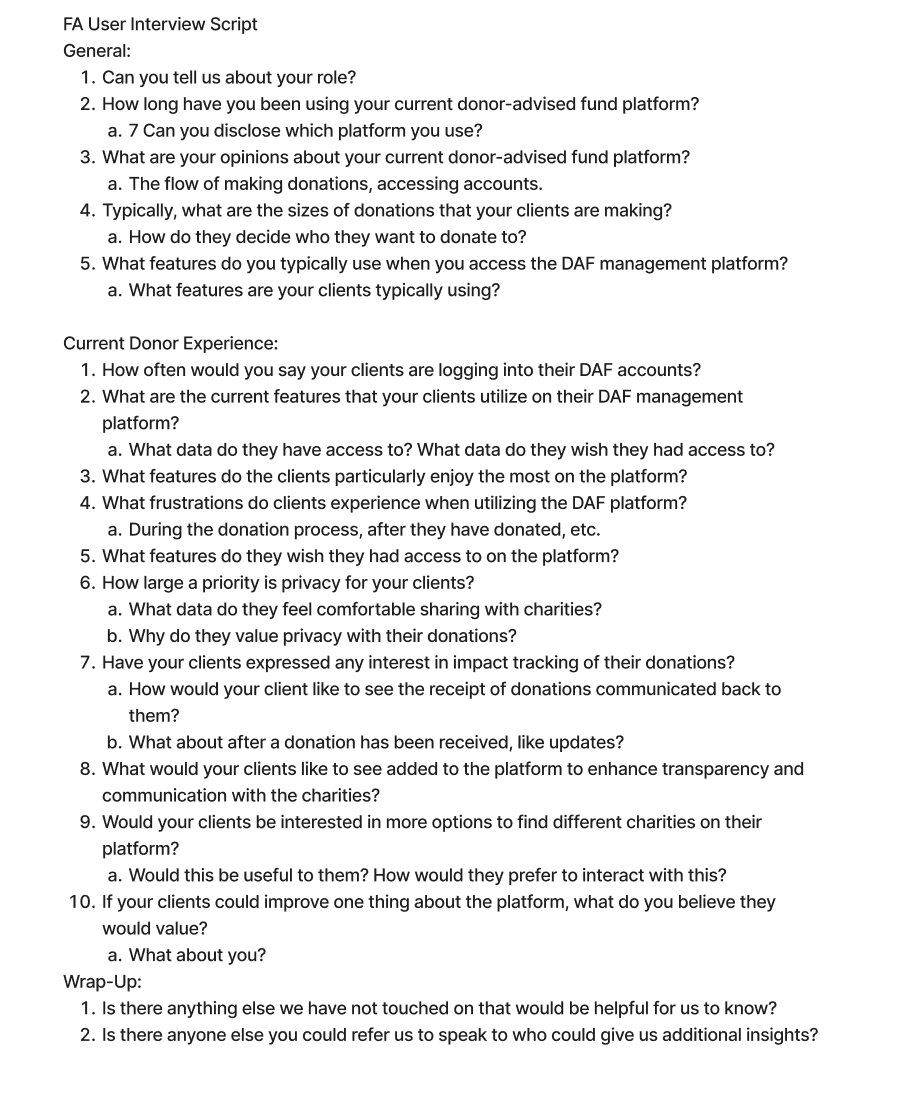
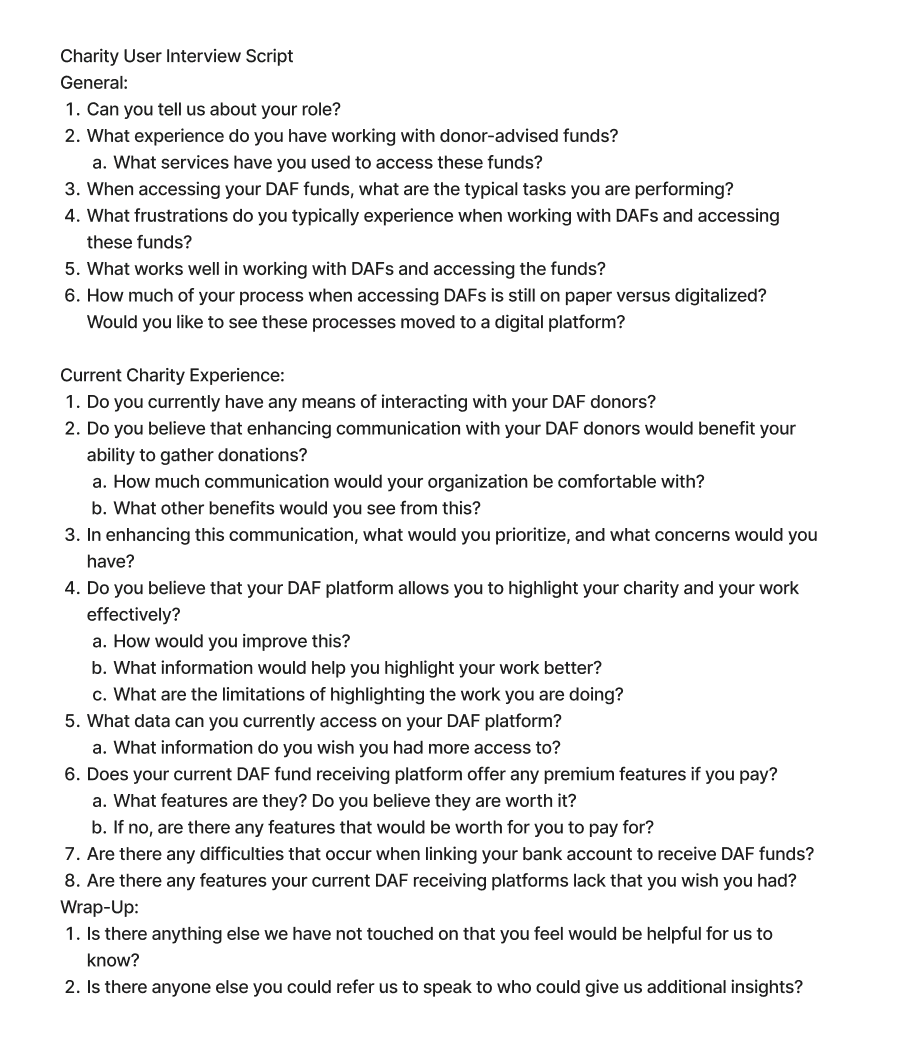
Interviewed 6 financial advisors who work with donors to manage their DAF and 6 charities who accept DAF funds to understand the varied motivations and respective experiences donors and charities have with DAFs
Secondary Research Results
The secondary research we conducted significantly enhanced our understanding of the market and the problem space. We were able to gather major findings at each stage that made us much more informed in conducting our primary research. Some of our major takeaways from this phase included:

Charities
Charities have highly variable capacity for donor communication, requiring stewardship solutions that are flexible and non-burdensome.

Donors
DAF donors value control over their engagement with charities, but their expectations vary widely based on motivation, net worth, and desired level of involvement.

Strategy
There's an opportunity to differentiate Ren by prioritizing donor experience, existing solutions either treat DAFs as an add-on or emphasize donor engagement without DAF functionality.
Primary User Research Design & Results
Going into the primary research phase, we were immediately hit with a hurdle: "How can we get permission to conduct research on donors?" Naturally, donors can be hard to access for numerous reasons:
Some donors donate anonymously, making them disinterested in being contacted by parties outside of their financial management teams
Financial advisors are hesitant to pass along their donor contacts out of concern for bothering them, since they are already very busy people
There is no repository of people who make donations via donor-advised funds.
Thus, we knew we would have to find ways to learn about DAF donors, even if we couldn't directly target them. This led to us recruiting financial advisors since 1 financial advisor could offer insights into the behavior of many donors.
Study Design
Our study consisted of interviews completed with 2 user groups: financial advisors and charity representatives. The groups were not offered incentives to participate.
6 Charity Representatives
Ranging in roles from gift managers, directors of donor outreach, and philanthropy officers. We strategically targeted a variety of charities, including 2 nationwide, 1 statewide, and 2 citywide. Cold emailing individuals found on charities' websites and LinkedIn pages.
6 Financial Advisors
We recruited financial advisors from the NAPFA (National Association of Personal Financial Advisors) database, filtering for advisors who specialize in charitable giving work.
Rationale
We used interviews to support both discovery and validation. While our partner brought an initial hypothesis around donor engagement and transparency, interviews allowed us to validate those assumptions and uncover broader donor needs if misalignment emerged. Open-ended questioning gave us the flexibility to probe participants’ lived experiences and understand not just whether transparency mattered, but why.
Findings
It was shocking to us how many charities and financial advisors speaking about their donors stated similar sentiments from their unique perspective. Both user groups were very aware of the needs of the other. Major themes we uncovered in our interviews included:
Finding: Impact Matters, but Effort Must Stay Low
Donors and charities expressed remarkably similar needs: both value transparency and impact visibility, but are cautious about overwhelming the other side with excessive communication.
Many donors don't want to put in additional effort to request updates or to become "that donor" who bothers stretched-thin charities.
Charities feel like they walk a tightrope with stewardship. They don't want to spam donors, but they also rely on outreach. They also note that stewardship is often the bulk of the work they do, so it's important to maximize value.
Recommendation:
Design communication tools that balance visibility with restraint, allowing impact updates to be shared without increasing administrative burden for charities or notification fatigue for donors.
Must offer more options for communication preferences than the current black-and-white anonymous or not setting.
Target lightweight impact storytelling, such as project-level updates or summaries, rather than granular donation tracking.
Finding: Acknowledgment Drives Donor Satisfaction
Donors consistently valued being acknowledged. Personalized, direct communication from charities made donors feel appreciated and informed. They also wish they could feel more connected to the donation they made beyond the acknowledgment.
Donors care more about communication that feels like it actually pertains directly to them and their giving, not generic outreach messaging.
We also uncovered that financial advisors believe that most of their clients with DAF funds were individuals already making charitable donations before setting up their accounts. They were motivated by philanthropy before learning of how they could maximize the tax benefits.
Recommendation:
Support features that allow charities to thank donors through acknowledgements as a one-time communication and share updates in a simple, repeatable way that fits into existing workflows.
Features must be flexible and match patterns that are familiar, requiring little onboarding to adopt.
Make a clear distinction between the acknowledgements (one-time) and the impact updates (on-going) so have a more granular understanding of what their opting in and out of communications means.
Finding: Anonymity Is Widely Misunderstood
Contrary to assumptions, very few DAF donors were anonymous. Charities and financial advisors also report donors being confused about what anonymity actually meant, often assuming that they were refraining from their information being shared publicly, not from the charity as well.
This resulted in donors who marked themselves to remain anonymous calling charities to check that their donation was received, upset that they never heard anything
from the charities.
Recommendation:
Clarify anonymity options through clearer language and controls, allowing donors to choose visibility levels and build the platform to manage communication for charities in line with the chosen donor preferences.
The platform must minimize the effort required by charities to perform outreach to their DAF donors and minimize scenarios of unwanted communication
Problem Statement
With the results of our research in mind, we began honing in on a problem statement and a how might we statement representative of our findings. While lengthy, they were designed with targeted research data from the user perspective, making it easier to communicate the user needs back to the stakeholders. It also allowed us to discuss findings that pertained to aspects of the user experience that our initial problem space did not address.
“As a donor,
When I’ve made my charitable contributions for the year,
I want to keep up with the donations I gave to charities, maintaining a connection,
So I can feel a greater sense of involvement from the impact my dollar has made,
But the current process offers little control or access to track if my donation was received, let alone creating a connection with my chosen charities,
Resulting in frustration from the all or nothing approach to communication with charities, creating a disconnect.”
How might we…
empower donors by allowing them to easily track and understand the impact of their contributions while preserving control and choice in communication with charities?
Design
With the research phase complete and our problem statement defined, it came time to begin ideating on how we would tackle this complex issue of control, connection, and communication.
Ideation
We started off our ideation session by reviewing our problem statement and findings, then completing a Crazy 8 sketching exercise. As we discussed the different ideas we came up with, we took note of where our ideas overlapped and what problems they addressed. From here, we took it to the whiteboard and started messily sketching and working through the main ideas we honed in on.


By the end of this session, we walked away with 3 ideas to present to Ren, before we started truly pursuing a final design. We prepped an outline of these ideas and basic sketched low-fidelity wireframes to discuss with the team:
Opt-In Preferences
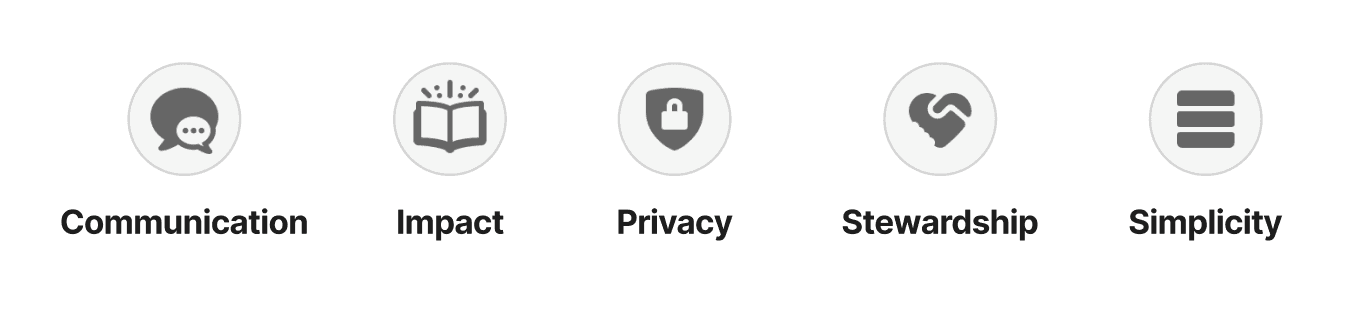
Relevant themes: Communication, Impact, Privacy
• Donors set their communication & charity preferences based on how often they like to see updates, industries, funding usage, etc.
• Charities tag their charities for matching with donors
• Backend manages tracking
• Match scores are displayed on charity profiles to inform donors and adjust to donor behavior, donors also rate charities after donating.
Individual Project Donations
Relevant themes: Impact, Stewardship, Simplicity
• Expand charity search and charity profiles by featuring individual projects
• Charities post selected projects that they feel they can reliably keep up with updates on
• Donors donate directly to the projects and are subscribed to project updates, receiving notifications in-line with their notification settings.
Donation Management Dashboard
Relevant themes: Communication, Impact, Simplicity
• Donors have a main account overview dashboard that's more giving-focused and less finance-focused
• Donors have access to social media feeds of the charities they give to, and the ability to message charities within the platform
• Charities can manage their DAF donors in one dedicated space
Our Solution
Under Ren's guidance, we decided to pursue individual project donations in our design, while adapting parts of our other ideas to be included. This was largely because it balanced the interests of donor who want an emotional connection to their philanthropy with those more interested in the tax benefit, as well as the needs of charities with varying resources and sizes regarding impact communication.
Inspiration
The context behind our chosen concept also served Ren by providing a unique, but universal giving experience.
Ema (Japan)
Our cultural reference started in Japan with Ema. Ema are little wooden plaques found on Shinto shrines. On one side, the writer notes something they wish for. On the other side, they draw an image, typically symbolic of their wish. Then, they hang it on a wooden rack for the gods to receive.

Learning about the concept of Ema in our desk research made us realize how this experience is truly universal. Every Christmas, stores place Angel Trees where children in need have their Christmas wishes hung for shoppers to fulfill. In Hinduism, worshippers tie a Kautuka/Kalava to various spiritual trees in the spirit of seeing their wishes come true. Prayer walls are common in churches all over.
In regards to digital design, we have incredibly popular donation platforms such as GoFundMe and Kickstarter allowing anybody to donate to individual causes. So why not bring this concept to DAF platforms where people can not only receive the benefits of their DAFs, but also know they are giving to reliable organizations they care about?
Design Walkthrough
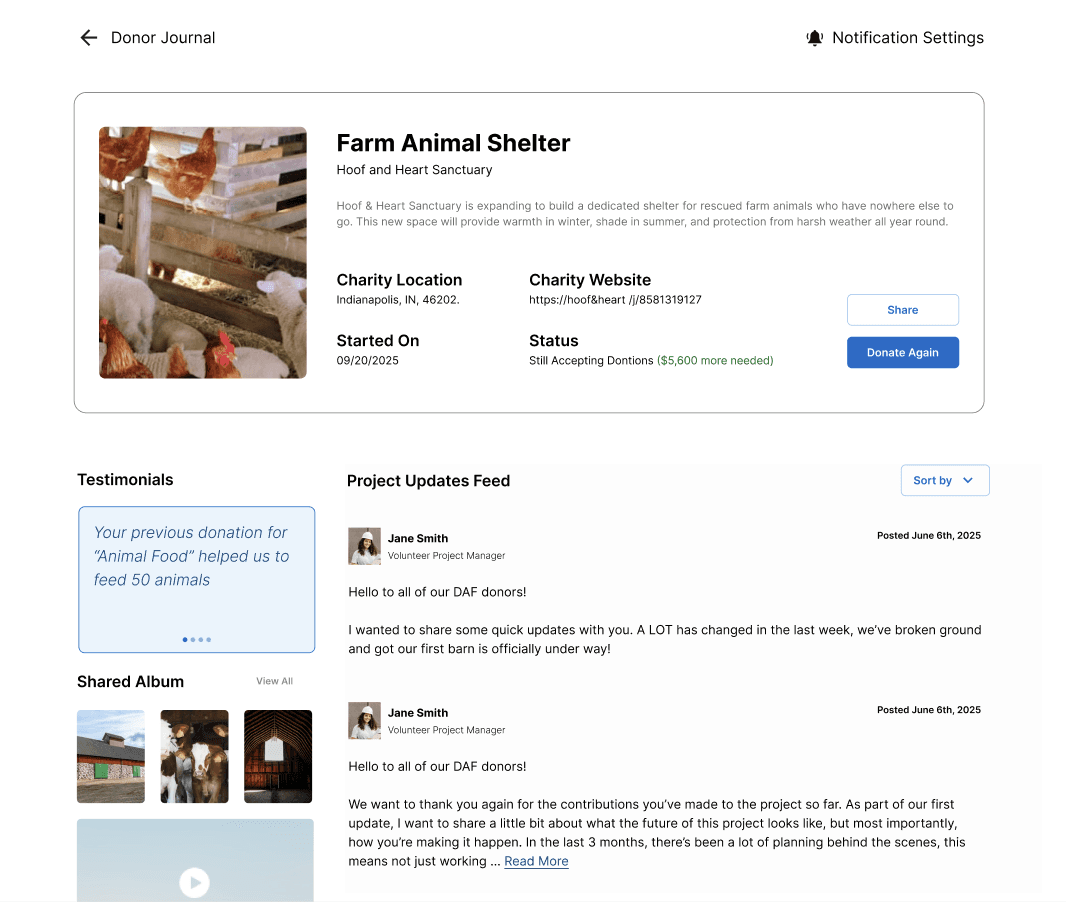
Individual Project Donations: Charities choose projects to post and receive donations for, with the expectation that they will provide impact updates to donors on their “Impact Profile.” Donors give to projects on their account dashboard, then access their donations and view these updates in their Donor Journal.
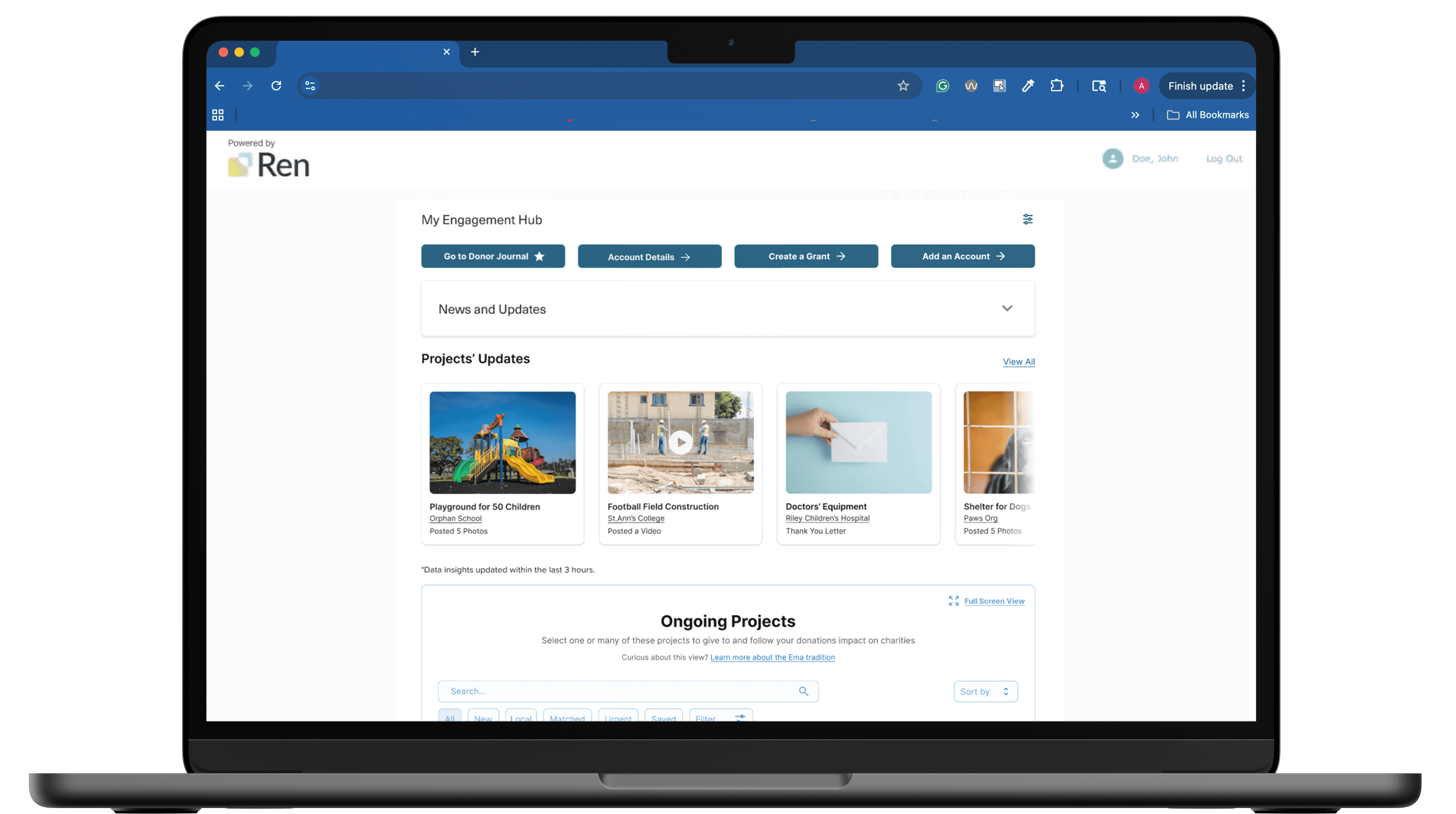
The Ongoing Projects wall was designed to tackle the themes of transparency and control
Gave charities control over which projects they post and updates are shared within their comfort level.
Lets donors choose projects they'd care about tracking, and includes custom notification settings to support engagement without over-communication
Designed flexible discovery (search, filters, visual cues) that appears front and center in the application, compared to the original process that was rigid and buried, and refined the ema-board inspiration into a culturally neutral, instructional layout
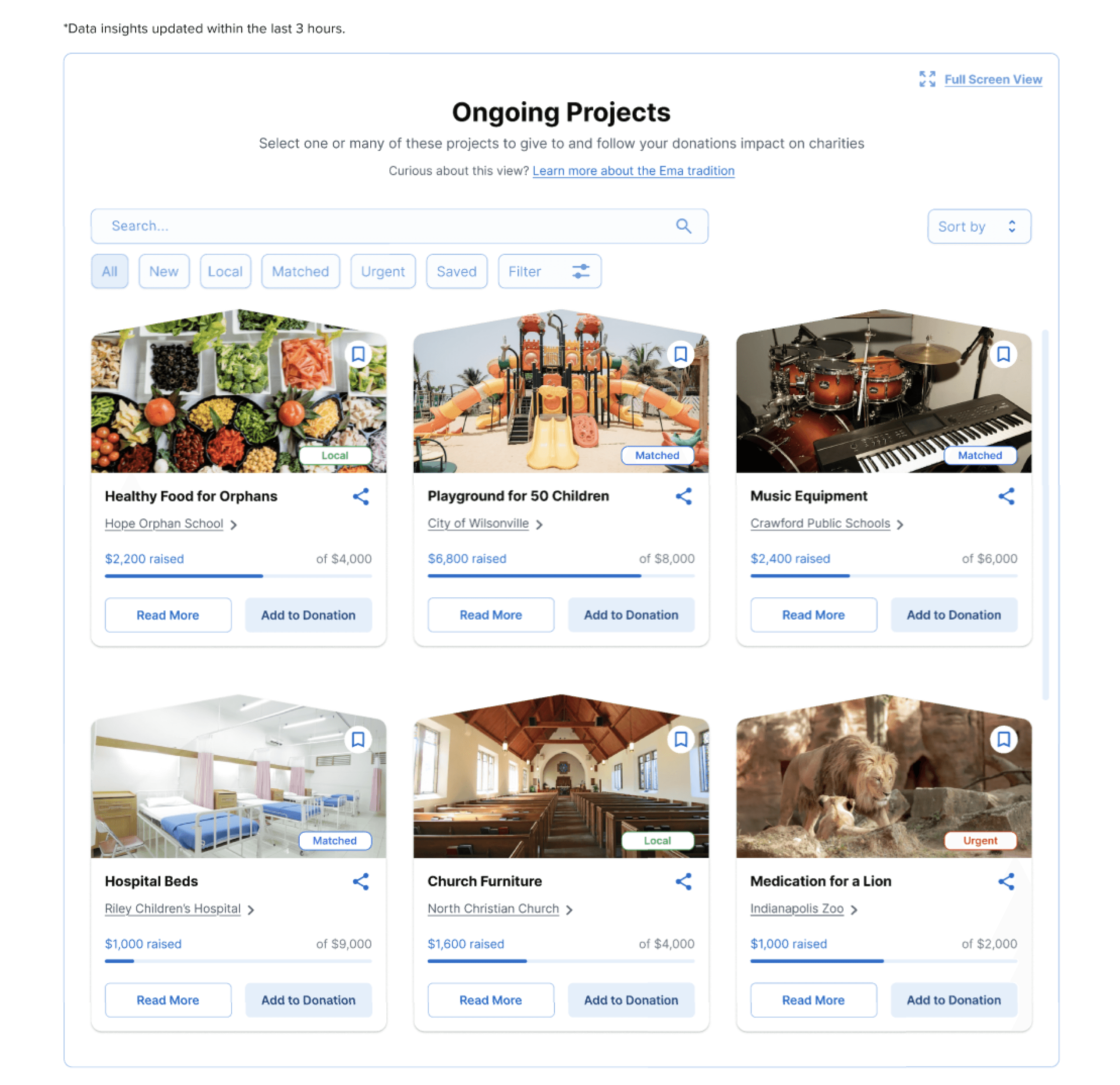
The Donor Journal was designed to make impact feel continuous and human
Prioritized visual storytelling (images, video, narrative updates) to close the loop emotionally, not just financially
Centralized updates from all donated projects into a single feed to support passive, ongoing engagement
Designed for AI-powered summaries and analytics to surface meaningful impact at a glance without adding cognitive load
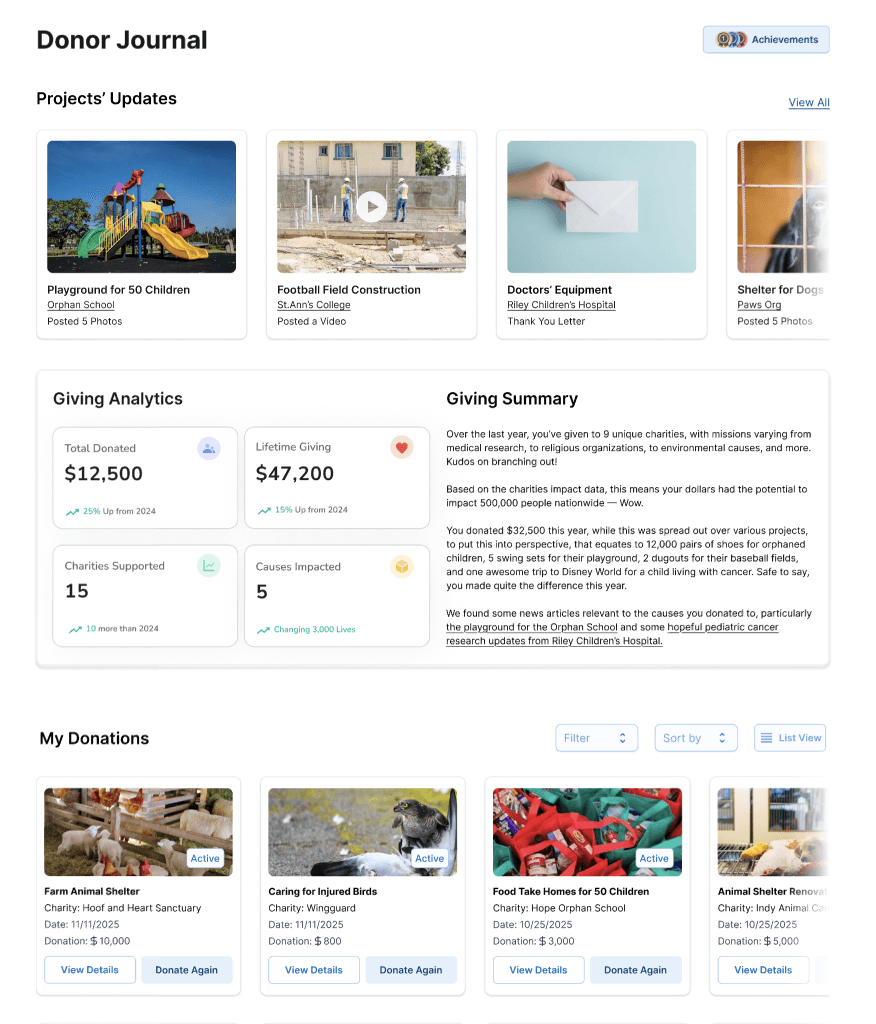
The Charity Profiles were designed to support trust through donors researching charities and flexibility in giving.
Surfaced key trust signals early to support donors who are still evaluating organizations
Preserved bulk donation paths for donors who prefer traditional, low-touch giving
Structured project listings as a simple carousel to maintain clarity and equity across charities of different sizes
Separated finished projects from active discovery to keep profiles focused and scannable
The Project Impact Profiles were designed to feel familiar, lively, and to tell the story of the project it represents.
Used familiar social media patterns to reduce friction across ages and tech comfort levels
Centralized key actions and project status in the header for quick understanding and re-engagement
Structured updates as a chronological feed with a dedicated media gallery
Clearly separated one-time acknowledgements from ongoing project updates to reduce communication confusion
Testing
For our testing phase, we were fortunate to be able to test with 3 donors, recruited with the assistance of Ren Inc. Testing sessions consisted of a task-based usability test, a modified A/B survey, and a final System Usability Scale.
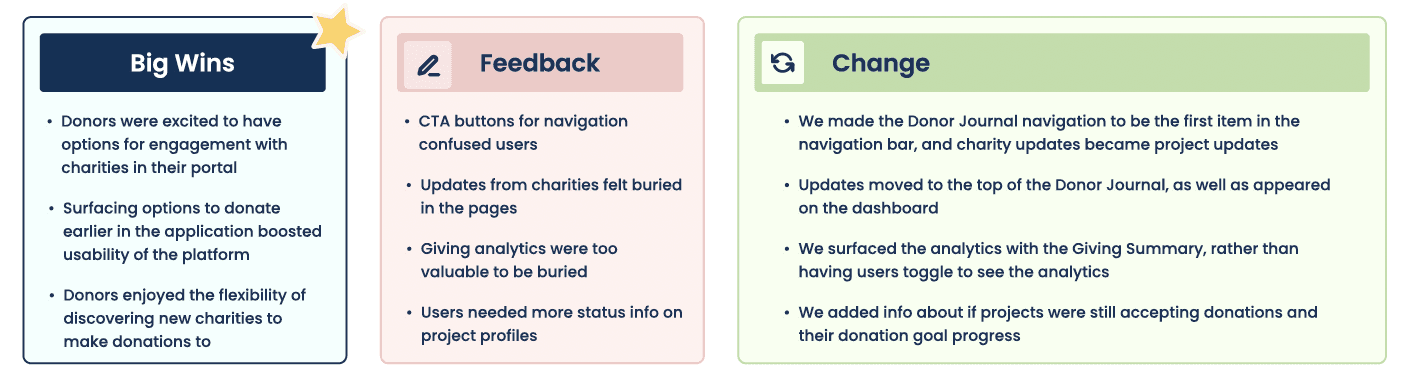
Overall, our testing results were excellent, with users being excited that, in our design, their donations became something they could follow and see the impact of. It wouldn't just be that they send a grant to a charity, receive a thank you, and then never hear about it again. However, there were small adjustments to make here and there that are already reflected in the design shown above.
Outcomes
This project marked the culmination of my Master's program in HCI.
Ultimately, our group was extremely proud of the work we accomplished throughout our collaboration with Ren Inc. We loved the complexity of the research and the creative problem-solving required for the design phase. Working with Ren further deepened my love for industries like fintech that require diligence and action for bringing innovation to life. Most importantly, I'm proud of the fact that our work was so well supported and received by the Ren team, that it's made its way on the Donor First platform's roadmap for 2026.
